Microscopic Endodontic Treatment 25–40× Magnification for Precision Root Canal Care
Using a dental operating microscope, ultrasonic instruments, and cone beam computed tomography (CBCT), microscopic endodontic treatment enables highly precise diagnosis and treatment. Magnification of up to 40× and high-resolution 3D imaging allow the dentist to identify and eliminate infection more accurately, even in challenging cases involving calcified or curved root canals, helping maximize the long-term preservation of your natural tooth.
Comparison
An advanced endodontic technique that combines a high-powered dental operating microscope, precision ultrasonic instruments, and 3D cone beam computed tomography (CBCT). These technologies allow the dentist to perform complex procedures with exceptional, micron-level precision.
Conventional Root Canal Treatment
Conventional root canal treatment uses standard instruments to remove infected pulp tissue before the root canals are cleaned, disinfected, and sealed to preserve the natural tooth. Because the procedure relies primarily on direct visual inspection and the dentist’s clinical experience, there may be limitations in identifying and treating complex root canal anatomy.
Benefits of a Dental Operating Microscope
Up to 40 × Magnification
High-powered magnification allows the dentist to clearly visualize details finer than a human hair, minimizing blind spots that may be missed with the naked eye.
Precision Diagnosis and Treatment
Bright, focused illumination and enhanced magnification make it possible to identify hidden anatomy and treat even the smallest areas with exceptional accuracy, helping preserve as much healthy tooth structure as possible.
Expert Care by an Endodontic Specialist
Treatment is performed by a highly trained endodontic specialist with advanced expertise in microscopic endodontics, ensuring precise, high-quality care.
Standard Clinical View
Magnified View Through a Dental Operating Microscope
Trusted Expert
Endodontics & Microscopic Root Canal Specialist
Dr. Brian Chang
Specialties
Microscopic Apical Surgery
Microscopic Vital Pulp Therapy
Teeth Whitening
Microscopic Treatment for Calcified and Curved Root Canals
Advanced Endodontic Treatment
Education and Experience
Microscopic Endodontic Operation Certification, Taiwan Board-Certified Endodontist by the Ministry of Health and Welfare, ROC Board-Certified Family Dentistry Specialist by the Ministry of Health and Welfare, ROC Attending Physician , Department of Endodontics, Taipei MacKay Memorial Hospital Attending Physician , Department of Family Dentistry, Taipei MacKay Memorial Hospital Specialty Training in Endodontics, Mackay Memorial Hospital Physician, Department of Stomatology, Taipei Veterans General Hospital Doctor of Dental Surgery, Taipei Medical University
Process
Step 1
Consultation & Evaluation
CBCT imaging and a detailed assessment are performed to evaluate the root canal condition and discuss the treatment plan.
Step 2 (If Needed)
Removal of Existing Crown & Temporary Crown Placement
If the affected tooth is covered by an existing crown, your restorative dentist will remove it before treatment and place a temporary resin crown to protect the tooth.
Step 3
Microscopic Root Canal Treatment
Treatment typically requires 1–3 visits. A dental microscope and ultrasonic instruments are used to clean, disinfect, and seal the root canal system.
Step 4
Final Restoration & Crown
Once root canal treatment is complete, your restorative dentist will rebuild the tooth as needed. This may include placement of a dental post, if necessary, followed by a permanent all ceramic crown.
A Conversation with Endodontist Dr. Brian Chang
Is Microscopic Endodontic Treatment Painful?
Adequate local anesthesia is administered before treatment, and most patients experience only mild pressure or vibration during the procedure. The dental microscope helps the dentist locate and clean the root canals more precisely, minimizing unnecessary irritation to surrounding tissues and improving overall treatment comfort.
How Long Does Microscopic Endodontic Treatment Take?
Treatment time varies depending on the complexity of the tooth. Most cases require one to three appointments, with each visit lasting approximately 30 to 60 minutes. More complex cases, including retreatment, may take longer.
How Long Does Microscopic Endodontic Treatment Take?
It may be recommended for complex root canal conditions, including:
Persistent pain or swelling after previous root canal treatment
Calcified or narrowed root canals
Curved or anatomically complex canals
Severe root canal infections
Cases requiring apical surgery or removal of separated instruments
Cases where greater treatment precision is desired
Why Does Microscopic Endodontic Treatment Sometimes Require Multiple Visits?
More severe infections often require treatment in stages. The dentist may first clean the root canals and place medication to control the infection before completing the final filling. If treatment is completed in a single visit, bacteria may not be thoroughly eliminated, which could affect the success of the treatment.
Complex root canal anatomy also requires more time and careful treatment. Therefore, the procedure may be completed over multiple visits depending on the condition of the tooth.
Will I Need a Crown After Root Canal Treatment?
In many cases, yes. Teeth that have undergone root canal treatment may have reduced structural strength, so a post and crown may be recommended to provide additional support and protection.
Schedule Your Visit
Transportation Information
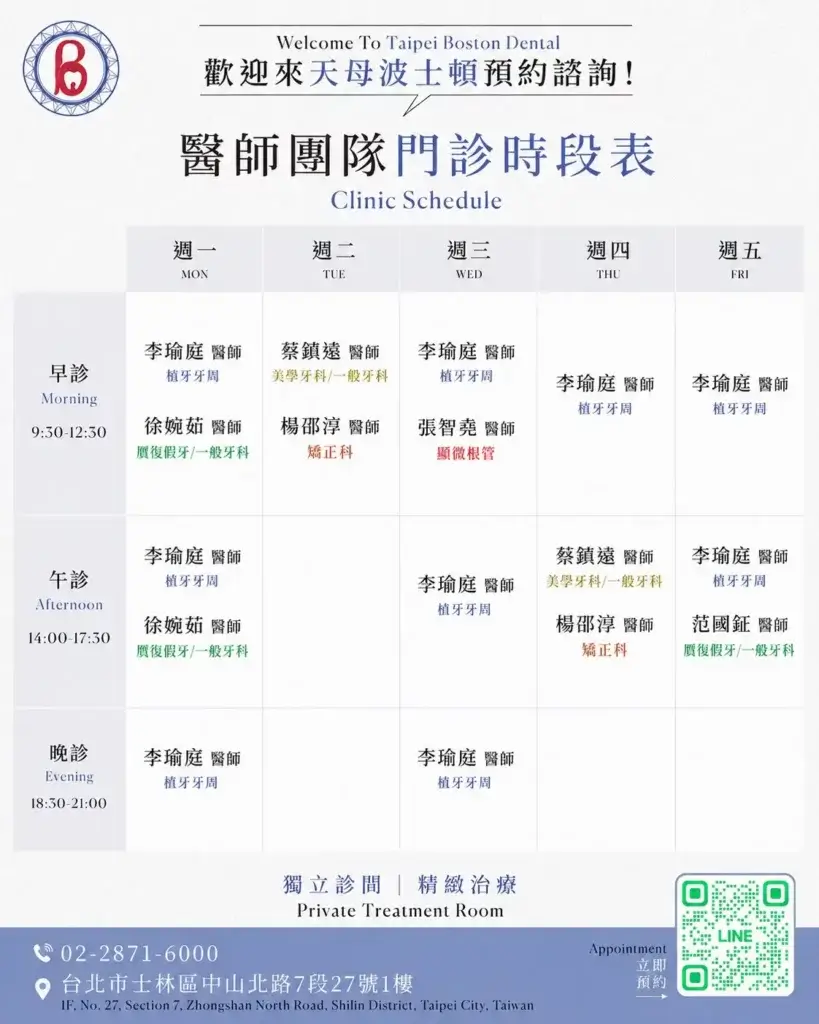
Address|1F, No. 27, Section 7, Zhongshan North Road, Taipei City By Bus|Tianmu Square Stop Parking|Tianmu West Side Parking Lot